
Every university and independent school should answer this strategic question before market forces answer it for them.
A recent newsletter by Kaihan Krippendorff from the Outthinker Network posed a question to corporate leaders under pressure to rethink their business models: “Are you protecting products or building capabilities?”
The context was a conversation between Krippendorf and John Fallon, the former CEO of Pearson plc, discussing its remarkable survival story. When Fallon took over, the company sold about 20 million college textbooks annually in its core business. A decade later, that number had dropped below one million, leading to the loss of two billion dollars in revenue. Pearson survived by recognizing that its true strength was never just publishing. It was about empowering people to improve their lives through learning. Fallon noted that the textbook “just happened to be the way we monetized it.”
Identifying the key difference—between what an institution monetizes and what makes it strong—may be the most urgent strategic challenge in higher education and independent schooling today. The original insight from Pearson applies directly: the product you sell is rarely what provides your resilience. Instead, it’s the underlying capability. Institutions that fail to distinguish between the two risk misjudging both their vulnerabilities and their opportunities.

Avoiding the Marketing or Mimesis Traps
When demand lags, the natural impulse is to market harder, but this approach is an uphill battle when your products lack distinctiveness or when demographic constraints apply. The cost to acquire each student—measured in both financial and calorie-hour of effort terms—quickly becomes prohibitive.
For example, four regional universities—three public and one private—have nearly identical billboards along the same four-mile stretch of highway near our office in St. Louis. All three emphasize personal attention, flexible class schedules for working adults, and lower costs of attendance compared to their peers. Each is using the same strategy: increase visibility and awareness through more aggressive marketing, all while selling essentially the same thing. However, this leads to commodification—making it difficult to distinguish between the institutions. How is one BS or MBA different from another?
Fallon warns that disruption poses a particular danger to strategy. Amid upheaval, organizations begin to borrow the qualities of other, seemingly more successful enterprises. “We want to become the Netflix of this or the Spotify of that,” he said, “instead of asking what it is we actually do that is of enduring value,” and doubling down on that factor.
Independent schools are not immune to this. Over the past decade, many have heavily invested in maker spaces, innovation labs, and STEM facilities — not because those initiatives stem from a clearly defined educational philosophy, but because competitors had them and parents of prospective students expected to see them. The product was protected. The deeper question about capability was never asked.
Universities face an even more acute challenge. Many have responded to online competition by creating digital course platforms, sometimes investing tens of millions of dollars to do what Coursera and edX do, but with more funding. They protected the lecture. They didn’t consider what a university truly does that no asynchronous video can replace.
Marketing and mimesis are traps, not strategies.
The Capability Reframe
Rather than focusing on selling more textbooks, Fallon’s reframing for Pearson was to clarify the “job to be done.” Not just publishing textbooks, but empowering people to advance in their lives through learning. Focusing on this capability opened the door to products beyond textbooks and formats beyond print media.
What is the equivalent clarification for education?
For independent schools, the product is often framed as academic preparation—getting students into selective colleges that, in turn, prepare them for careers in finance, consulting, or the professions. But if that were genuinely the core capability, then demographic shifts, the test-optional movement, AI, and the growing legitimacy of alternative pathways would constitute existential threats. For schools that have confused the product with the purpose, they already do.
But consider a different framing: what if the job to be done is to form young people with the habits of mind, character, and relational intelligence to tackle messy, real-world problems? That capability doesn’t disappear when college admissions patterns change. It deepens in value as AI commoditizes information recall and credential inflation renders degrees alone insufficient.
For universities, a parallel question surfaces. Is the job to be done credentialing or employment readiness? Or is it producing a particular kind of intellectual transformation that can only happen through sustained proximity to scholars, peers, and inquiry—the residential learning community that no algorithm has yet replicated? Credentialling and employment readiness verge on becoming commodities, while the latter arises from the unique, irreplaceable factors in each institution’s identity.
Products and Formats Versus Capabilities
This isn’t wordplay. It changes what leaders actually do on Monday morning.
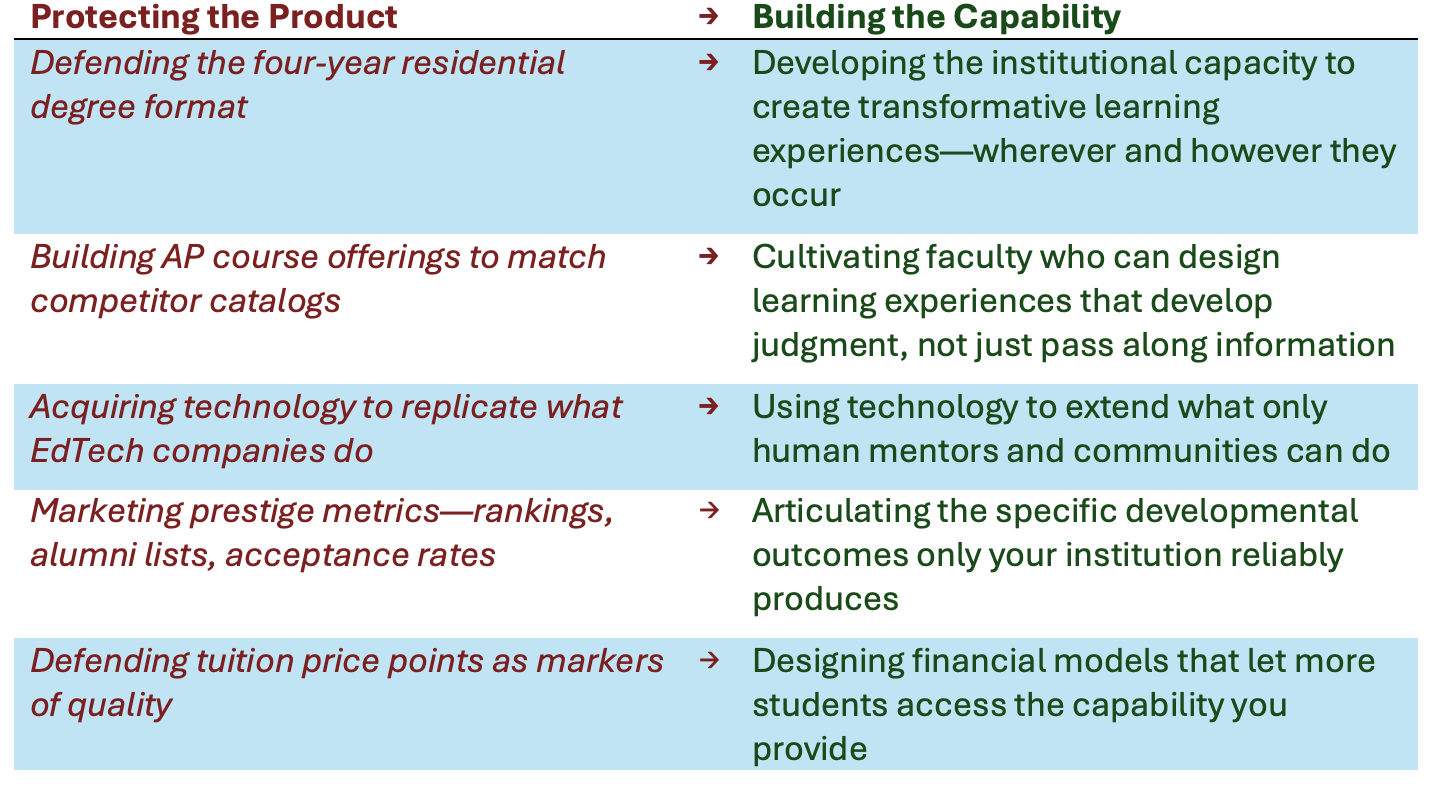
To break it down a bit further, we can distinguish between capabilities, products, and formats. A capability is an underlying organizational competency that enables the delivery of enduring value — regardless of the product or format. It’s what you can do that is genuinely hard to replicate.
Products are what you are actually selling — the things the “customer” transacts to get. A diploma. An AP score. A college placement. A specific course of study. Products have identifiable features, can be compared to competitors’ offerings, and are what show up in a typical marketing brochure.
A format is a delivery mechanism or structural container for products. The semester system, the credit hour, the residential campus, the 45-minute class period, and the AP course are all examples of academic formats. Formats are the how of delivering the products.
So, the hierarchy is roughly: Capability → expressed through Products → delivered via Formats. Fallon’s point about Pearson is that they confused the product (the textbook) with the capability (helping people progress through learning). The textbook was one product expression of that capability, delivered in a particular format (print, sold through campus bookstores).
In the education context, an independent school might:
Have a capability in developing ethical reasoning and intellectual courage in adolescents;
Express that through products like a Harkness pedagogical model, an honor code program, or a capstone thesis; and
Deliver these through formats like the school day, long class blocks, advisory periods, and semester-long courses.
Confusing product with capability is the existential error — it’s what nearly killed Pearson and threatens schools that define themselves with products such as “college prep” or “AP schools.” If the product loses relevance, you think you’ve lost your reason for being.
Confusing a format with a product is an operational error. However, still costly — it’s what happens when a school assumes the traditional school day is the education, rather than one vehicle for it. It produces rigidity without clarity.
The most defensible position — and the one worth building institutional strategy around — is when you can show credible evidence of both: that an outcome demonstrably occurs in your students, and that the conditions producing it are genuinely specific to your institution.
What Capability-Focused Institutions Do Differently
When institutions identify their genuine capabilities—the things they do that are of enduring value—their decision-making changes in specific, observable ways.
They invest in people, not just programs. Capabilities reside in people—in the judgment of experienced teachers, the institutional knowledge of long-tenured administrators, and the culture maintained by alums who return as mentors. Product-focused institutions cut people when enrollment drops. Capability-focused institutions recognize that the people are the product.
They protect culture more fiercely than curriculum. Courses change. Scheduling models change. The relational ethos of an institution—whether students feel genuinely known, challenged, and held accountable—is far harder to rebuild once it erodes. Capability-focused institutions treat culture as infrastructure.
They make a purpose load-bearing. Fallon noted that during Pearson’s hardest years, what held people together was not optimism but meaning. Purpose explained why the pain was worth it. For educational institutions facing enrollment pressure, financial restructuring, or competitive threats, the purpose needs to be specific enough to guide hard trade-offs—not decorative language on a website.
They separate monetization from mission. Tuition based on credit hours is how many universities monetize their value. It is not the value itself. Institutions that conflate the two defend their price point as if it were the mission, even when doing so restricts access to the very capability they claim to offer. Once you pull those apart, you can even consider models that are usually off-limits: competency-based pricing, income-share agreements, hybrid residential–online structures, and others.
The Questions Boards and Leadership Teams Should Be Asking
Fallon offered a short checklist for corporate leaders. Adapted for educational institutions, the questions become:
• What do we produce in students that is genuinely hard for other institutions to replicate — and how do we know? That answer is your capability.
• Are we defending formats because they work, or because we’re comfortable with them? The residential classroom, the school year, the semester system, the course credit—these are formats, not capabilities.
• Where have we borrowed someone else’s identity? When we describe ourselves as ‘innovative’ or ‘21st-century’ or ‘STEM-focused,’ are those descriptions anchored in what we actually do well, or are they marketing language that doesn’t quite fit?
• Can our community see why the hard changes are worth it? If you’re restructuring, reducing, or redirecting resources, the capability framing is what makes the pain worth it.
• Are we focused on work only we can do? What do we provide that the well-funded EdTech platform, the tutoring app, and the online degree program genuinely cannot replicate?
If the answer to the first question is something like “preparation for study and life at university,” then two more questions are appropriate:
“How do we know we produce it?” is an assessment question. It asks whether you have any systematic evidence that the outcome you claim really occurs. Most schools have almost none. They have anecdotes, alum testimonials, and college placement data — none of which isolates what the school itself caused. This is genuinely hard, and the honest answer at most institutions is: we believe it, we see signs of it, but we haven’t designed the rigorous feedback loops to know it.
“How do we know it’s hard to replicate?” is a question in a competitive analysis. It asks whether you’ve looked at what peer institutions do and whether your claimed capability is genuinely distinctive or simply what everyone in your market claims. Most schools haven’t done this analysis either. They assert distinctiveness without examining it.
The reason both distinctiveness and ease of replication matter strategically is that they fail in different directions. If you produce something real but it’s easily replicated, you have a capability that will not sustain competitive advantage for long. Someone else will copy it, probably at a lower cost.
If you claim something distinctive but can’t demonstrate that you produce it, you have a marketing position without an operational foundation. That is a reputational risk waiting to surface.
Earning Longevity, Not Chasing Relevance
The Outthinker newsletter summarized Pearson’s story this way: it is not about chasing disruption. It is about earning longevity. It starts with knowing who you are before deciding how to change.
That framing should resonate deeply in education, where the tendency under pressure is often to add—new programs, new facilities, new marketing language—rather than to clarify. Clarity about capability is harder than just activity. It requires boards and school leaders to ask uncomfortable questions about what they are authentically good at and what they are merely doing.
The institutions that will earn longevity are not the ones with the most innovative brand story. They are the ones that can look their communities in the eye and say, with specificity and conviction: this is the job we exist to do, this is what makes us uniquely capable of doing it, and this is why it matters more now than ever.
Everything else is just a product.